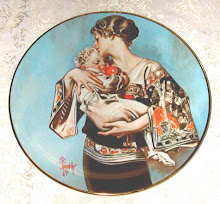
, Ann Crittenden argues that motherhood has an enormous economic impact; that if you think about parenting as the creation of workers, workers that are the basis of our economy, then mothers are one of the largest contributors to the GDP. This view is obviously an offspring of Marxism, which seems appropriate because whether or not we wish to admit it, Marxism has permeated our thought processes and cultural values. Which is why, I argue, we have to say something makes motherhood "worth it."
And most definitely, motherhood has no economic value for the mother herself. In fact, most women suffer serious financial consequences when having children (and when they get married. See Gilbert's Committed: A Skeptic Makes Peace with Marriage
 for more on that). Not only does raising children cost money, lots of money, there is the lost earning potential. Time taken for pregnancy and child birth, for children's doctor's appointments and illnesses, even for school recitals all has a negative impact on a woman's earning potential. [See Motherhood Rising for more].
 But not everything can be measured in terms of economic output, the arts for example have an economic value but have worth beyond that. Motherhood's relation to the economy is unique. It is essential to the continuation of the economy and the species. Everyone has a mother and to become a productive part of society, children need someone to oversee their development. Sadly, even though motherhood is a vital part of the economy, that same economy does not value motherhood. Nor, necessarily, should it.
I do not wish to say that mothers don't have value, because they do. My point here is that motherhood does not fit in the predominately Marxist view of value and worth. A system which was originally structured by men.
While I haven't done any research, it seems to make sense that the comment of being a parent is "worth it" was not uttered until the onset of birth control. If one asked a working class Victorian mother of four, who was glad just to have survived childbirth, if being a mother was "worth it" I think she would either slap you, laugh, or stare uncomprehendingly. Perhaps I will ask my grandmother, because I think even her generation would not quite comprehend the question.
And perhaps that's why this saying has entered our vernacular in this regard. Now that women have a "choice" as to whether or not to have children, why would any sane, rational woman make that choice. Why would she give up a proportion of her economic worth to suffer through sleepless nights?
There is the age old argument that what is traditionally woman's work is devalued; nurses, teachers, etc all have low wages. Parenting, of course, has no wage associated with it. While I am more than willing to concede that keeping wages for jobs that traditionally belonged to women low was a form of oppression, [why, if women actually earned a livable wage, they won't need us men!] I think there is more at work here.
Cultural historians who departed from the Marxist who came before them were willing to admit that economic forces shaped history, but they insisted that cultural forces had an impact too. It seems that part of the reason that care giving historically has a low to non-existent wage is that it is not based in economies, at least not traditional economies. It is something that went on long before the first barter between human beings occurred. It is something that all animals participate in on some level. Perhaps, motherhood cannot be contained within economic thinking, it deserves a completely different approach and set of parameters. And I'm sure I'm not alone in trying to figure out what those parameters might be.